Photographing the Flåm Railway and the fjords
The Flåm Railway gives you about an hour of steep valley scenery, but the seats are first come and the windows are glass. Between the five-minute waterfall stop and the open deck of the fjord boat, the good pictures come from being in the right spot at the right moment. Gear matters less than you might think.
No reserved seats on the Flåm Railway
The Flåm Railway (Flåmsbana) runs about 12.5 miles (20 km) between Flåm on the fjord and Myrdal up on the mountain, climbing through 20 tunnels on one of the steepest standard-gauge lines in the world. Tour groups ride it with ordinary tickets, and nobody gets an assigned seat. One reviewer on the lunch tour summed it up bluntly, "the train is not set seats." Whoever boards first takes the windows, and in summer the carriages fill.
The view also changes sides. The track winds from one slope of the valley to the other and doubles back through tunnels, so neither side wins for the whole ride. Rather than fighting for a seat, many photographers stand in the open space by the carriage doors, where windows on both sides are within reach. Give way to anyone getting on or off at the small stations, and return to a seat if staff ask you to.
Shooting through the train windows
Glass and tunnels cause most of the trouble. Hold the lens or phone almost against the window so reflections from inside the carriage cannot creep in, and switch off the flash, which only lights up the pane. Dark clothing throws back far less light than a bright jacket. When the train plunges into a tunnel your camera will push its exposure up, so wait a second or two after you come back into daylight before you shoot again.
Use a fast shutter, 1/500 s or quicker, because the carriage sways and the foreground rushes past. Frame the far side of the valley rather than the rocks beside the track, which blur at any speed. On a phone, tap the distant slope to focus there instead of on the glass, and lock the exposure if the screen keeps brightening for the dark window frame.
Five minutes at Kjosfossen
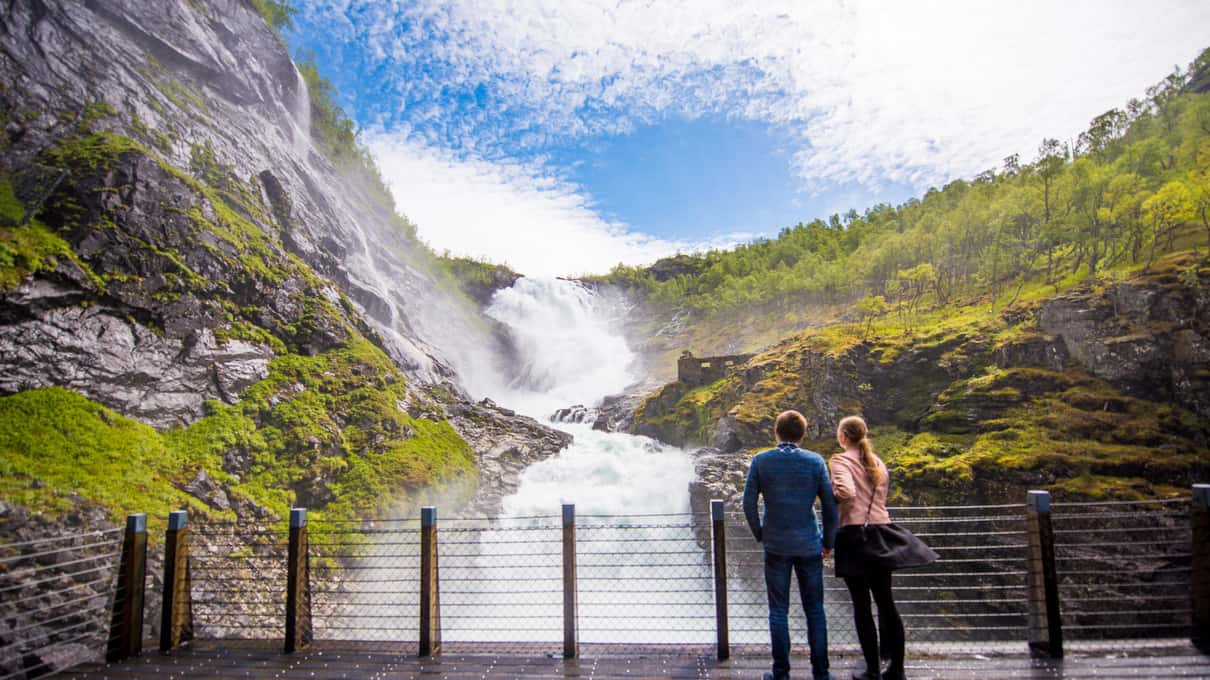
Partway along the line the train stops for about five minutes at Kjosfossen, and everyone steps out onto a viewing platform facing the falls. Five minutes go fast with a full train behind you. Step off promptly and take the wide shot of the whole fall first, then turn to details. The spray is heavy, above all in May and June when snowmelt swells the river, so keep a lens cloth in a dry pocket and turn your back to the falls between frames.
In summer a costumed dancer, the huldra of Norwegian folk legend, appears on the rocks beside the water. She moves, so use burst mode rather than a single frame. Stay near the train doors at the end, because the stop is short and the train runs to a timetable.
The boat deck on the Nærøyfjord
The fjord cruise is where most people take their favorite pictures. The Nærøyfjord, a UNESCO-listed arm of the Sognefjord, narrows to about 820 ft (250 m), and cliffs rise almost straight from the water on both sides. A wide lens or a phone's ultra-wide camera fits the walls into one frame, while a short telephoto picks out small farms on the ledges and waterfalls threading down the rock. Go out on deck rather than shooting through the cabin glass.
Which way you sail changes the light. On the Fjordrive day at ~$459 the boat leaves Gudvangen at 12:10 pm and reaches Flåm at 2:10 pm, while Travenor's first schedule sails the other way in the afternoon. The Guided Fjord Tours day at ~$417 uses an all-electric boat with panoramic windows and an outdoor deck. Crowds can be the bigger obstacle. One reviewer on the lunch tour at ~$408 described an old boat so full that people fought for space at the rail, so head outside early and hold your spot.
Fewer elbows at every stop
Travenor's small-group day from ~$518 caps the group at six and adds Stegastein to the railway and the fjord cruise. Reviewers say they never felt rushed, which helps when you want a second try at a shot.
Stegastein in midday light
The Stegastein viewpoint juts about 100 ft (30 m) out from the mountainside, 2,130 ft (650 m) above the Aurlandsfjord. Tours reach it between late morning and mid-afternoon, from 11 am or noon on Travenor's schedules and at 3:30 pm on Fjordrive's. High sun flattens the fjord and puts glare on the water, so expose for the bright sky and let the shadows go dark, or fit a polarizing filter to cut the shine. Clouds drifting over the fjord add depth if you wait a minute for a patch of light to land on the far shore.
The classic frame shows the platform's curving walkway with the fjord far below. Step back toward the road to fit the whole curve in, then walk to the end for the view straight down the water. Stegastein or the Viking village compares the two add-ons the tours differ on.
Waterfalls from the road
Tvindefossen, a roadside waterfall near Voss, is a regular stop on the drive to the fjord. It drops about 381 ft (116 m) in steps, the height given on the Fjordrive Viking Village tour at ~$395. Fjordrive pulls in around 10 am and the lunch tour allows 20 minutes, enough to walk close for the spray and back out again for a wider frame. A phone's long-exposure mode turns the water silky if you brace the phone on a railing.
The private tour from ~$912 also stops at Stalheim, where the view drops into the Nærøydalen valley, a viewpoint missing from the shared tours' itineraries. With a private car you can also ask the driver-guide to pull over when the light is good.
Rain on the lens and phone batteries
Bergen weather will wet your lens at some point in the day. A microfiber cloth kept in a dry pocket and a lens hood solve most of it. Rain also does photographers favors, since low cloud hanging in the valleys and swollen waterfalls look better in pictures than a flat blue sky. Our packing guide covers rain gear for you and your bag.
Phones do well on this trip. Stick to the main lens and skip digital zoom. Switching on the grid helps keep the fjord's horizon level, and a power bank keeps you going through a 10- to 13-hour day. To see when the waterfalls run fullest, read our season guide. An hour in Flåm suggests where to point the camera during your free time, and which tour to choose sets the five main options side by side.